
Phone(954) 496-6649
Proudly serving Broward County

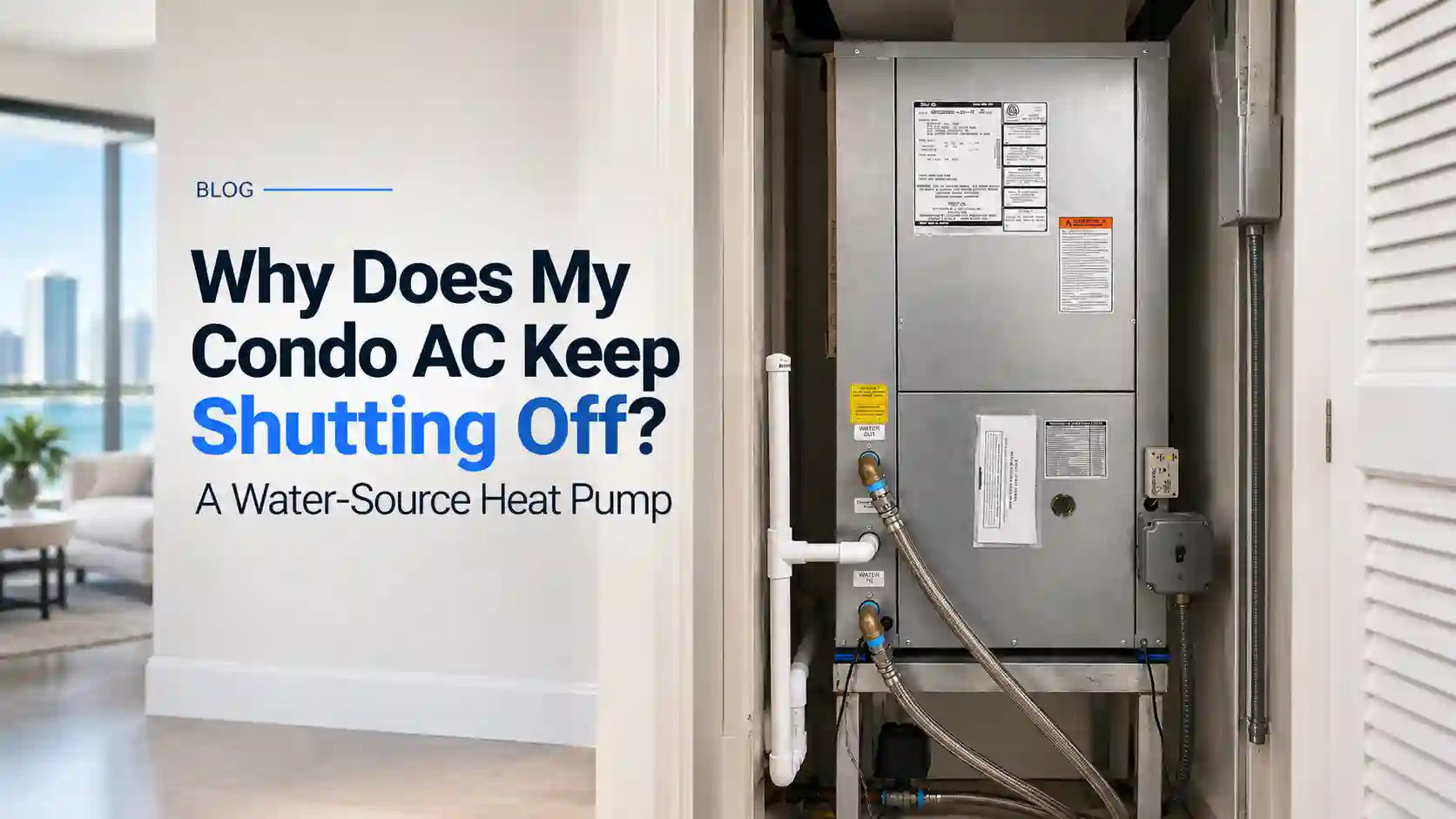
It is the middle of a South Florida afternoon, the apartment is warming up and the air conditioner has stopped again. You reset it, it runs for a while, and then it shuts off one more time. If you live in a condo or a high-rise, this is one of the most common problems we see, and the cause is usually different from what happens in a house.
Most condo buildings along the coast, from Hollywood Beach and Hallandale Beach up to Fort Lauderdale, cool each apartment with a water-source heat pump instead of a regular split system. Once you understand how that system works, it is much easier to figure out what is going on and to explain it to building management or a technician.
A condo AC that keeps shutting off is usually protecting itself. Water-source heat pumps have safety controls that stop the compressor when the pressure inside the system climbs too high. The most common reason is low water flow, either from the building’s cooling tower loop or from the valves at your unit. A clogged drain line or a failing electrical part can also make it shut down.
Unlike a house, your apartment has no outdoor unit. The whole system sits in one cabinet, usually in a closet or above the ceiling. It pulls the heat out of your apartment and hands it to water that flows through a coil inside the unit, called the heat exchanger. That water then travels through a loop that serves the whole building and up to a cooling tower on the roof, where the heat is released.
The water is what carries the heat away. If not enough of it reaches your unit, the heat has nowhere to go. The pressure inside the system rises, and a safety switch turns the compressor off before it gets damaged. That is the shutdown you are seeing.
If the cooling tower is down, a pump fails or the building is doing maintenance on the loop, units on several floors can start shutting off at the same time. In that case the problem is not inside your apartment.
Each unit has two water valves, one for the water coming in and one for the water going out. After plumbing work, or simply because old valves stop opening all the way, the flow to your unit can drop even when the building loop is working fine.
Debris in the water collects in a small strainer, and over the years minerals build up as scale inside the heat exchanger. Both restrict the water flow little by little, so the unit runs worse every summer until it starts tripping.
The unit also removes moisture from the air, and that water leaves through a drain line. When the line clogs, the pan fills up and a float switch turns the system off to keep water out of your floor and your neighbor’s ceiling.
A weak capacitor, a worn contactor or a control board problem can also make the unit stop, sometimes with a buzz or a click when it tries to start again.
Before anything else, find out whether the problem is only in your apartment. It saves time and points you to the right person.
In most buildings the association maintains the cooling tower and the water loop, while the owner is responsible for the unit inside the apartment. Your condo documents confirm exactly where that line is.
Every shutdown is the system telling you something is wrong. Restarting it again and again while the cause is still there forces the compressor to start under high pressure, and the compressor is the most expensive part of the unit. A problem that starts as a clogged strainer can end as a compressor replacement.
A good rule: reset it once. If it shuts off again within a few hours, turn it off and call for service.
On a water-source unit we start with the water side: the flow, the valves, the strainer and signs of scale in the heat exchanger. Then we check the refrigerant pressures, the electrical parts and the drain. You get a clear explanation of what we found and the price before any work starts. If the water has to be shut off for the repair, we coordinate it with building management.
If the unit is old and the heat exchanger or the compressor is worn out, we go over the cost of repairing it against replacing it, so you can decide with real numbers. You can read more about how we work on these systems on our water-source heat pump service page.
Most units do not have a reset button you can easily reach. On many systems, turning the unit off at the thermostat for about five minutes and then back on clears the safety lockout. If yours has a reset on the unit itself, it is usually behind an access panel, and that is best left to a technician.
In most buildings the owner pays for repairs to the unit inside the apartment, and the association pays for the cooling tower and the water loop. Your condo documents spell out the exact split.
A single shutdown after a building water outage is not a concern. If it keeps happening, something is wrong, and running it that way puts the compressor at risk.
It is not recommended. The strainer sits on the water line, and opening it means shutting off the water and working with lines under pressure. It is a job for a technician.
Condo AC shutting off?
We service water-source heat pumps in Hollywood and across South Broward.
Call 954-496-6649 Request Service
Mon – Sat, 8:00 AM – 8:00 PM. You get the price before any work starts.